Use AI to assess AI impact on your business
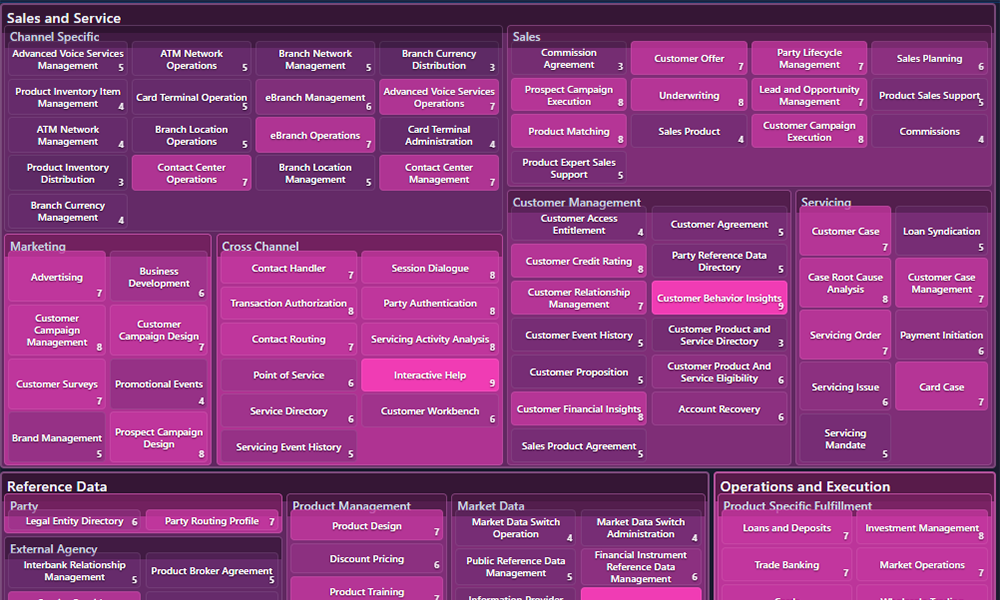
While waiting for a plumber on a Saturday morning, I started a bit of vibe coding on an idea that was hanging round after I'd looked at what Andrej Karpathy had done last week with his US Job Market Visualizer.
Andrej Karpathy's project maps U.S. occupations against their exposure to AI, showing which jobs are most likely to be transformed and which are most protected. It's a cool piece of work and wanted to extend the concept and create a general tool that can be used to access AI impact on any business, assuming the business can be expressed as a hierarchal capability model or equivalent in a CSV file.
The Enterprise Architect's Problem
If you're an enterprise architect, or anyone responsible for technology strategy, you've almost certainly been asked some version of this question in the last year: "Where should we invest in AI?" "What parts of our business will be disrupted?" "Where are the opportunities?"
It's a deceptively hard question to answer. Not because the technology is mysterious (most of us have a reasonable sense of what LLMs, agentic AI, and automation can do) but because the answer depends entirely on your organisation's specific capability landscape. A bank's answer is different from a hospital's. A retailer's is different from a government agency's.
And yet most of the AI impact analysis I've seen falls into one of two camps:
-
Too high-level. Sweeping statements about industries or functions. "AI will transform financial services." Yes, but where, and how much, and when?
-
Too vendor-specific. Product pitches dressed up as strategy. "Our platform automates claims processing." Fine, but that's one capability out of hundreds.
What's missing is a systematic way to assess AI impact across an entire capability model. Many industries have standard frameworks for this: BIAN for banking, TM Forum's Open Digital Architecture for telecoms, IEC CIM for utilities, or APQC process frameworks. But you don't need an industry framework. Any expression of your business as a hierarchy with reasonable descriptions will do, whether it's an internal capability model, a service catalogue, or even an organisational breakdown.
What It Looks Like
To test the tool, I ran it against the BIAN Service Landscape v13, the Banking Industry Architecture Network's standard capability model. The assessment covers 217 service domains across the full banking landscape: sales and servicing, operations, risk, compliance, product management, corporate finance, payments, trade finance, and more.
Live demo: here.
The output is an interactive treemap where colour indicates the selected metric. Different colour themes are available. You can switch between AI Opportunity, AI Disruption, Composite Impact, Timeline, and Human-in-the-Loop views. Hover for a summary, click for full detail including use cases and risks.
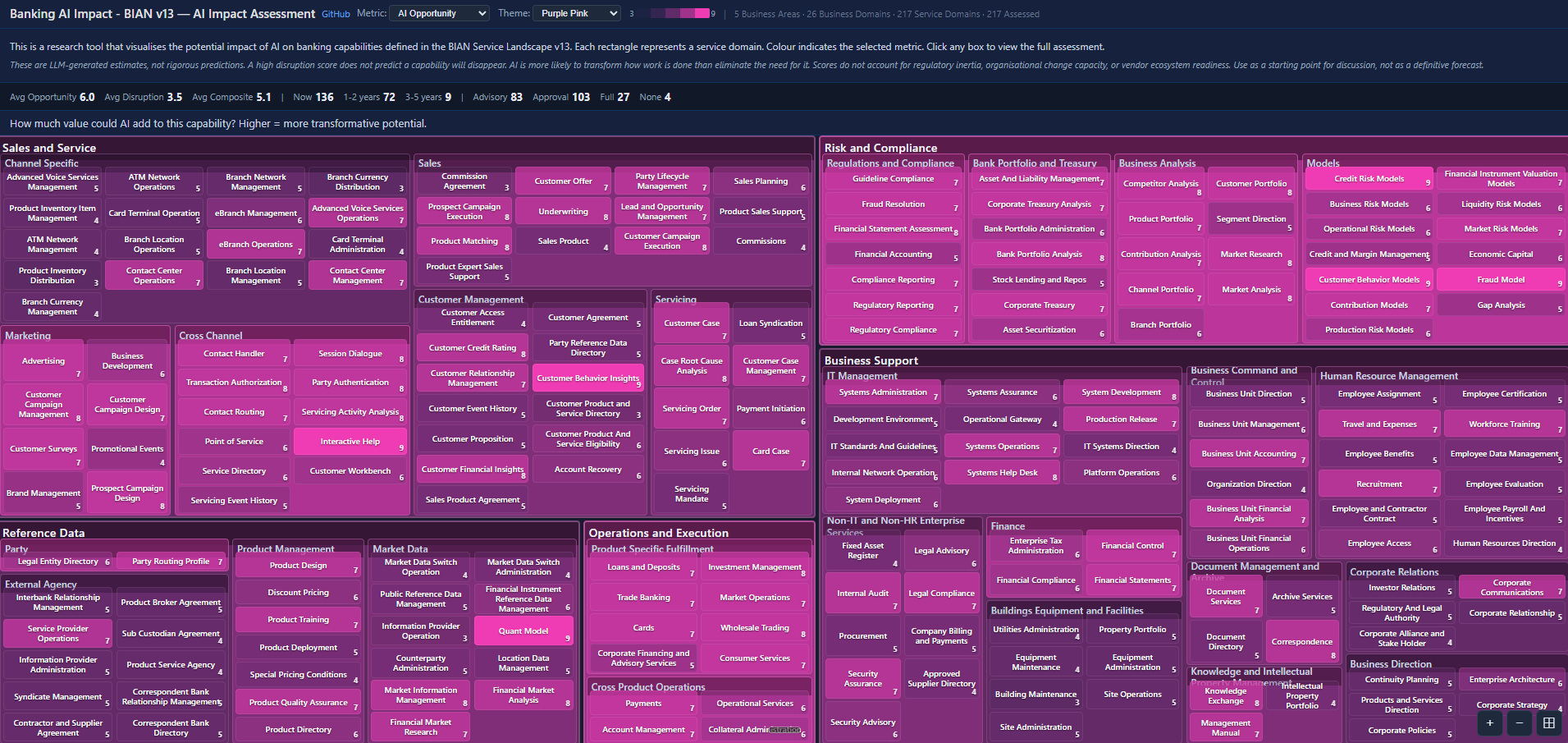
Some patterns that emerged from the banking assessment:
-
High opportunity, low disruption. Many operational capabilities (transaction processing, document management, compliance monitoring) score high on opportunity but low on disruption. The capability isn't going away; it's being enhanced.
-
High disruption pockets. A few areas, particularly around manual document handling and basic customer servicing, show genuinely high disruption scores, where the current form of the capability may not survive AI transformation.
-
Timeline variation. Not everything is "now." Many capabilities are in the 3-5 year window, gated by regulatory approval, trust requirements, or the complexity of the judgement involved.
-
Human-in-the-loop patterns. The visualisation makes it immediately obvious where full human oversight remains non-negotiable versus where AI can operate with advisory or no oversight.
Or course, a caveat that this is a research tool and LLM output hasn't been curated, but it's a good start.
It's Not Just for Banking
The tool is completely domain-agnostic and capability model agnostic. The BIAN example is a demonstration. You can point it at any hierarchical CSV: TOGAF capability maps, APQC process frameworks, IT service catalogues, organisation taxonomies, or whatever model you already have.
If you can express it as a CSV with levels and descriptions, the tool can assess it. A flat list of processes works just as well as a three-tier capability model.
How It Works
The tool is a Python pipeline with three stages. You provide a CSV with your hierarchy. The tool computes a treemap layout, then batches your leaf-level items and sends each batch to an LLM for structured assessment. Each item gets scored on AI opportunity (0-10), AI disruption (0-10), timeline, human-in-the-loop requirement, use cases, key risks, and a composite impact score. The results are embedded into a single standalone HTML file you can open in any browser or put on your website.
The prompt is designed to produce realistic assessments. It tells the LLM that not everything benefits from AI, that a well-argued 2 is more valuable than an inflated 6, and that opportunity and disruption are independent dimensions.
Everything is configuration-driven. You don't need to touch the code to adapt it to a different domain.
A Saturday Morning Build
The entire tool was built using vibe coding with Claude Code. The agents handled the boilerplate, the visualisation, the batch processing logic, and the prompt engineering iterations. My job was architecture: deciding what the tool should do and how the pieces fit together.
This is the kind of tool that would have taken days or weeks in a traditional development cycle. The Saturday morning version isn't a prototype. It's a working tool that produces genuinely useful output.
Caveats
The scores are LLM-generated estimates, useful as a starting point for discussion and prioritisation, not as definitive predictions. They don't account for regulatory inertia, organisational change capacity, or vendor ecosystem readiness. But they give you a structured, visually navigable starting point that would take weeks to produce manually.
Try It Yourself
The tool is open source and free to use, including use in commercial and enterprise settings. You can't sell it as a product or as part of a product, but you can use it freely in your own work.
Live demo (with BIAN banking example): here.
GitHub: github.com/dermot-obrien/ai-impact-assessment
The README in the repository has everything you need to get started: installation, configuration, how to customise the assessment prompt for your domain, and how to run it without API access.
Dermot O'Brien is an enterprise architect and AI strategist. He builds open-source tools for AI-assisted architecture work. Connect on LinkedIn or explore the project on GitHub.